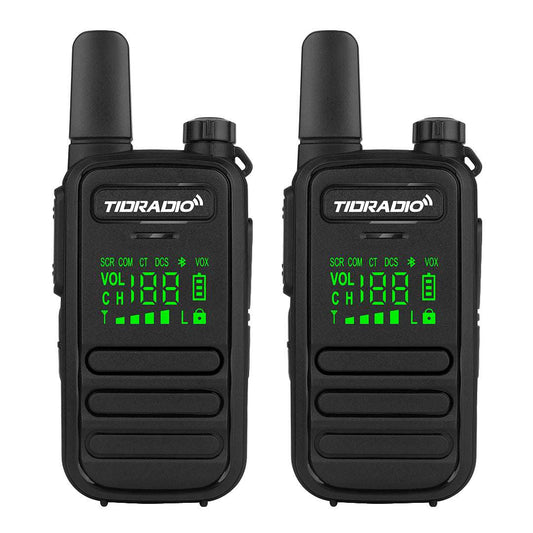
Explicación de las funciones de los walkie-talkies: frecuencias, repetidores y clasificaciones IP
Los walkie-talkies han recorrido un largo camino desde las simples radios de pulsar para hablar. Las radios bidireccionales modernas pueden incluir canales meteorológicos de la NOAA, soporte para repetidores GMRS, múltiples bandas de frecuencia, Bluetooth, GPS, APRS y diferentes niveles de protección contra el polvo y el agua.
Pero, ¿qué significan realmente todas estas características?
Si está comparando walkie-talkies para acampar, hacer senderismo, todoterreno, preparación ante emergencias, trabajo o comunicación cotidiana, comprender la terminología puede ayudarle a elegir una radio que se adapte a sus necesidades.
En esta guía, explicaremos algunas de las funciones de walkie-talkie y términos de radio más importantes, incluyendo frecuencias meteorológicas NOAA, repetidores GMRS, IP56, IP57, IP67, frecuencias ISM y código Morse.
1. Entendiendo las frecuencias de los walkie-talkies
Una frecuencia de radio determina cómo una radio bidireccional transmite y recibe señales inalámbricas. Diferentes servicios y dispositivos de radio operan dentro de distintos rangos de frecuencia, y la frecuencia utilizada puede afectar el comportamiento de las señales en diferentes entornos.
Dos rangos de frecuencia comunes en radios portátiles son VHF (Very High Frequency o Frecuencia Muy Alta) y UHF (Ultra High Frequency o Frecuencia Ultra Alta).
VHF frente a UHF
Las frecuencias VHF generalmente funcionan bien en entornos exteriores abiertos donde hay una línea de visión relativamente clara. Las frecuencias UHF suelen ser útiles en áreas con edificios, estructuras y otros obstáculos.
Esta es una de las razones por las que las radios UHF son populares para aplicaciones tales como:
- Sitios de construcción
- Almacenes
- Eventos
- Recreación al aire libre
- Comunicación familiar
- Comunicación GMRS
Sin embargo, la frecuencia por sí sola no determina el alcance de la radio. La altura de la antena, el terreno, los obstáculos, la potencia de transmisión, el rendimiento de la antena y la disponibilidad de repetidores pueden afectar la distancia de comunicación.
Para una explicación más profunda sobre el alcance real de GMRS, consulte nuestra guía sobre ¿Hasta dónde puede llegar una radio GMRS? Explicación del alcance en el mundo real.
2. ¿Qué son las frecuencias meteorológicas NOAA?
Una característica útil para la comunicación al aire libre y en emergencias es el acceso a la Radio Meteorológica de la NOAA.
Si ha buscado frecuencias meteorológicas NOAA, es posible que haya notado que la Radio Meteorológica NOAA utiliza varias frecuencias dedicadas en la banda meteorológica VHF.
Las siete frecuencias de Radio Meteorológica NOAA más utilizadas son:
| Canal NOAA | Frecuencia |
|---|---|
| WX1 | 162.550 MHz |
| WX2 | 162.400 MHz |
| WX3 | 162.475 MHz |
| WX4 | 162.425 MHz |
| WX5 | 162.450 MHz |
| WX6 | 162.500 MHz |
| WX7 | 162.525 MHz |
Estas frecuencias brindan acceso a información meteorológica y alertas de las estaciones de Radio Meteorológica de la NOAA.
Para excursionistas, campistas, cazadores, conductores todoterreno y usuarios de preparación para emergencias, tener acceso a la información meteorológica de la NOAA puede ser útil cuando las condiciones climáticas cambian rápidamente.
¿Por qué es útil la NOAA en un walkie-talkie?
Las condiciones meteorológicas pueden cambiar rápidamente en entornos al aire libre. Una radio con recepción meteorológica NOAA puede brindarle otra forma de monitorear la información del tiempo sin depender completamente de un teléfono inteligente o una conexión de datos móviles.
Por ejemplo, es posible que desee verificar la información meteorológica antes de:
- Comenzar un viaje de senderismo
- Dirigirse a las montañas
- Ir de campamento
- Iniciar una ruta todoterreno
- Prepararse para condiciones meteorológicas severas
- Planificar un evento al aire libre
Por lo tanto, la recepción NOAA es más que una función adicional de radio: puede ser parte de una configuración de comunicación al aire libre más amplia.
Para obtener más ideas sobre el uso de radios para la preparación ante emergencias, consulte nuestra guía sobre Radio GMRS para Comunicación de Emergencia.
Consejo: La recepción meteorológica NOAA no es lo mismo que la comunicación GMRS. Las frecuencias NOAA se utilizan principalmente para recibir información meteorológica, mientras que los canales GMRS se utilizan para la comunicación bidireccional bajo las reglas aplicables.
3. ¿Qué son los repetidores GMRS?
Si desea comunicarse a mayor distancia con una radio GMRS, es posible que encuentre el término repetidor GMRS.
Un repetidor GMRS es un sistema de radio que recibe una transmisión en una frecuencia y la retransmite en otra. Debido a que los repetidores suelen instalarse en lugares elevados, pueden ayudar a extender la comunicación más allá del alcance directo de radio a radio.
El concepto básico es el siguiente:
Radio A → Repetidor GMRS → Radio B
Sin un repetidor, dos radios portátiles generalmente necesitan una ruta de señal adecuada entre ellas. Con un repetidor, este puede recibir la señal y retransmitirla desde una ubicación más alta.
¿Por qué usar un repetidor GMRS?
Los repetidores GMRS pueden ser particularmente útiles para:
- Grandes propiedades
- Zonas rurales
- Terrenos montañosos
- Grupos todoterreno
- Clubes al aire libre
- Grupos de caza
- Comunicación de emergencia
- Comunicación comunitaria
Sin embargo, un repetidor no hace mágicamente que todas las radios se comuniquen a distancias ilimitadas. El terreno, la ubicación del repetidor, la altura de la antena, la configuración de la radio y las condiciones de la señal siguen siendo importantes.
Comunicación GMRS mediante repetidor frente a comunicación simplex
Hay dos formas básicas en las que las radios GMRS pueden comunicarse.
La comunicación simplex significa que una radio transmite directamente a otra radio en el mismo canal.
La comunicación mediante repetidor utiliza una estación repetidora entre las radios.
El simplex puede ser conveniente para una comunicación cercana, mientras que un repetidor puede ser útil cuando necesita superar limitaciones de distancia o terreno.
Si desea mejorar su distancia de comunicación, consulte nuestra guía sobre Cómo mejorar el alcance de la radio GMRS: Consejos para una mejor comunicación.
4. Cómo encontrar repetidores GMRS cerca de mí
Una de las búsquedas más comunes de los usuarios de GMRS es "repetidores GMRS cerca de mí".
Si planea utilizar un repetidor, el primer paso es averiguar si hay uno disponible en su área.
Puede buscar información sobre repetidores GMRS locales a través de directorios de repetidores, comunidades GMRS, clubes de radio y grupos de comunicación locales.
Antes de usar un repetidor, verifique:
- Su ubicación
- Par de frecuencias
- Requisitos de tono CTCSS o DCS
- Área de cobertura
- Si está abierto a usuarios generales
- Cualquier requisito de acceso
- Pautas operativas locales
Su radio también necesita admitir la configuración de repetidor adecuada.
Esto es especialmente importante si viaja. Un repetidor que funciona bien cerca de su hogar puede no ser útil cuando se encuentra a cientos de kilómetros de distancia.
¿Todas las radios GMRS admiten repetidores?
No necesariamente.
Al elegir una radio GMRS, verifique si admite canales de repetidor GMRS y si puede configurar la relación de frecuencia de recepción/transmisión y los ajustes de tono requeridos.
Para los usuarios que desean más flexibilidad de programación, radios como la TIDRADIO H3 Plus pueden ser útiles porque admiten funciones relacionadas con GMRS y repetidores junto con capacidades de frecuencia más amplias.
5. ¿Qué significa IP57 en un walkie-talkie?
Otra especificación que puede ver al comparar radios es una clasificación IP.
IP significa Ingress Protection (Protección contra ingreso). La clasificación describe qué tan bien está protegido un dispositivo contra la intrusión de partículas sólidas y agua bajo condiciones de prueba definidas.
Por ejemplo, una clasificación IP57 contiene dos números:
- 5 = protección contra el polvo
- 7 = protección contra la inmersión temporal en agua bajo las condiciones de prueba especificadas
Esto hace que los equipos con clasificación IP57 sean útiles para muchos entornos al aire libre donde el polvo y la exposición ocasional al agua son una preocupación.
Pero IP57 no es la única clasificación que puede ver en una radio bidireccional.
6. IP56 frente a IP57 frente a IP67: ¿Cuál es la diferencia?
Entender la diferencia entre IP56, IP57 e IP67 puede ayudarle a elegir una radio para su entorno.
| Clasificación | Protección contra sólidos | Protección contra el agua | Uso típico |
|---|---|---|---|
| IP56 | Protegido contra el polvo | Protección contra chorros de agua potentes | Sitios de trabajo y uso al aire libre |
| IP57 | Protegido contra el polvo | Protección contra inmersión temporal | Entornos al aire libre y húmedos |
| IP67 | Estanco al polvo | Protección contra inmersión temporal | Uso resistente al aire libre |
El primer dígito se refiere a la protección contra partículas sólidas, mientras que el segundo dígito se refiere a la protección contra el agua.
IP56
IP56 proporciona un 5 para la protección contra partículas sólidas y un 6 para la protección contra el agua. La clasificación de agua significa que la carcasa está protegida contra chorros de agua potentes bajo las condiciones de prueba pertinentes.
IP57
IP57 combina un nivel 5 de protección contra partículas sólidas con un nivel 7 de protección contra el agua. La diferencia clave con respecto a IP56 es la prueba de agua: IP57 está diseñado para la inmersión temporal bajo condiciones de prueba especificadas.
IP67
IP67 combina:
- 6 para una protección estanca al polvo
- 7 para protección contra inmersión temporal
Esto hace que IP67 sea especialmente atractivo para los usuarios que utilizan radios regularmente en entornos al aire libre exigentes.
Sin embargo, una clasificación IP no debe interpretarse como una escala simple de "un número más alto es siempre mejor". Los dos dígitos describen diferentes tipos de protección, y las diferentes pruebas de agua no son acumulativas automáticamente.
7. ¿Por qué IP67 es importante para los walkie-talkies de exterior?
La comunicación al aire libre puede exponer una radio a mucho más que un uso normal en interiores.
Una radio puede encontrarse con:
- Polvo
- Lluvia
- Barro
- Salpicaduras de agua
- Manos mojadas
- Clima cambiante
- Condiciones difíciles al aire libre
Por esta razón, los usuarios que pasan mucho tiempo al aire libre pueden considerar una radio con un mayor nivel de protección contra el ingreso.
TIDRADIO TD-638: Una opción resistente para la comunicación al aire libre
Para los usuarios que desean una radio portátil más completa para la comunicación al aire libre, vale la pena considerar la Radio portátil TD-638 10W IP67 APRS GPS Bluetooth.
La TD-638 combina 10W de salida, protección IP67, GPS, APRS y Bluetooth, lo que la convierte en una opción sólida para usuarios que necesitan más que una comunicación de voz básica.
Puede ser particularmente útil para:
- Aventuras todoterreno
- Senderismo
- Acampar
- Exploración al aire libre
- Preparación para emergencias
- Actividades de radioafición
- Usuarios que desean capacidades GPS y APRS
Si su prioridad es una radio portátil resistente para un uso exigente al aire libre, IP67 es una de las especificaciones a las que vale la pena prestar atención.
8. ¿Qué es ISM?
Otro término que puede encontrar al investigar la comunicación inalámbrica es ISM.
Entonces, ¿qué es ISM?
ISM significa Industrial, Scientific and Medical (Industrial, Científico y Médico).
Las bandas ISM son porciones del espectro de radio designadas para aplicaciones industriales, científicas y médicas, aunque muchas tecnologías inalámbricas modernas también operan dentro de estas bandas.
Un ejemplo bien conocido es la banda ISM de 2.4 GHz, que es ampliamente utilizada por tecnologías como Bluetooth y Wi-Fi.
¿Por qué ISM es importante para los usuarios de radio?
Entender ISM puede ayudar a explicar por qué diferentes dispositivos inalámbricos pueden operar en diferentes partes del espectro de radio.
Sin embargo, un dispositivo ISM no es lo mismo que una radio GMRS.
GMRS es un servicio de radio específico con sus propias asignaciones de frecuencia y requisitos operativos, mientras que ISM se refiere a bandas de frecuencia designadas utilizadas para una variedad de aplicaciones.
Al comparar productos inalámbricos, es importante mirar más allá de los términos de marketing y comprender la banda de frecuencia real y la tecnología de comunicación que se está utilizando.
9. ¿Por qué aprender código Morse para la comunicación por radio?
El código Morse puede parecer un método de comunicación antiguo, pero sigue siendo una habilidad interesante para los entusiastas de la radio y las personas interesadas en la comunicación de emergencia.
Si desea aprender código Morse, no necesita memorizar todo el alfabeto de una vez.
Comience con unos pocos caracteres simples:
- E = .
- T = -
- S = ...
- O = ---
Una de las señales de código Morse más conocidas es:
SOS = ... --- ...
¿Por qué sigue siendo útil el código Morse?
Aprender código Morse puede ser útil para los entusiastas de la radio, el interés histórico y el conocimiento de la comunicación de emergencia. También puede ser una forma divertida de desarrollar su comprensión de la comunicación por radio.
El código Morse tiene varias ventajas como método de comunicación:
- Se puede aprender gradualmente
- Requiere muy poco ancho de banda
- Tiene una larga historia en la comunicación por radio
- Es útil para los aficionados a la radio
- Puede ser parte del conocimiento de comunicación de emergencia
10. ¿Qué características de los walkie-talkies son más importantes?
Con tantas especificaciones de radio disponibles, puede ser difícil saber qué características realmente importan.
La mejor radio depende de cómo y dónde planee usarla.
Para la comunicación diaria en equipo: TIDRADIO H3 SE
Si necesita una radio portátil sencilla para la comunicación en equipo, sitios de trabajo, gestión de propiedades, uso familiar o actividades generales al aire libre, la Radio TD-H3 SE 5W AM/FM UHF/VHF es una opción práctica.
Ofrece:
- Salida de 5W
- Capacidad UHF/VHF
- Soporte GMRS
- Recepción meteorológica NOAA
- Funcionalidad USB-C
- Programación inalámbrica
- Controles PTT duales
Su diseño compacto la hace conveniente para usuarios que desean una radio capaz sin pasar a un modelo más grande o más especializado.
Mejor para: Comunicación diaria, equipos, sitios de trabajo, uso familiar y principiantes.
Para características avanzadas y comunicación flexible: TIDRADIO H9
Para los usuarios que desean mayor potencia y funciones de radio más avanzadas, la Radio portátil TD-H9 10W APRS GPS Bluetooth es otra opción.
La H9 ofrece:
- Hasta 10W de salida
- GPS
- APRS
- Bluetooth
- Amplia cobertura de frecuencia
- Capacidad GMRS
- Soporte para repetidores
Puede ser una buena opción para los entusiastas de la radio y los usuarios al aire libre que desean características adicionales de comunicación y seguimiento.
Mejor para: Usuarios avanzados, comunicación al aire libre, entusiastas de la radio y usuarios que desean funcionalidad GPS/APRS.
Para Bluetooth y un uso versátil de la radio: TIDRADIO H3 Plus
La Radio Bluetooth Ham GMRS TD-H3 Plus de 5W está diseñada para usuarios que desean más flexibilidad en una radio portátil.
Admite:
- GMRS
- Comunicación VHF/UHF
- Canales meteorológicos NOAA
- Funciones de repetidor
- Accesorios Bluetooth
- Programación inalámbrica
- Múltiples funciones de comunicación
El H3 Plus es especialmente útil para usuarios que desean una radio versátil que pueda evolucionar con sus intereses.
Ideal para: Principiantes que buscan más funciones, usuarios de GMRS, entusiastas de la radio y usuarios que desean conectividad Bluetooth.
Para comunicación robusta en exteriores: TIDRADIO TD-638
Si la durabilidad en exteriores y las funciones avanzadas son sus prioridades, la TD-638 destaca por su protección IP67, salida de 10W, GPS, APRS y capacidades Bluetooth.
Ideal para: Off-roading, senderismo, acampada, exploración al aire libre, preparación para emergencias y entornos exigentes.
11. Lista de verificación rápida de funciones de walkie talkie
Antes de comprar una radio bidireccional, considere estas siete funciones:
1. Compatibilidad de frecuencia
Asegúrese de que la radio sea compatible con el rango de frecuencia o servicio de radio que planea usar.
2. Soporte para repetidores
Si necesita una comunicación GMRS extendida, busque compatibilidad con repetidores GMRS.
3. Recepción meteorológica NOAA
Para uso en exteriores y emergencias, la recepción meteorológica NOAA puede proporcionar un acceso útil a información y alertas del tiempo.
4. Clasificación IP
Si usa su radio frecuentemente al aire libre, verifique si tiene una clasificación IP adecuada.
5. Capacidad de la batería
Los viajes largos al aire libre requieren suficiente duración de batería para toda la actividad, especialmente cuando las oportunidades de carga son limitadas.
6. Potencia de salida
Una mayor potencia de transmisión puede ser útil, pero recuerde que el alcance también depende del terreno, el rendimiento de la antena, la elevación y otros factores.
7. Funciones adicionales
Dependiendo de sus necesidades, funciones como GPS, APRS, Bluetooth, escaneo y programación inalámbrica pueden agregar una comodidad significativa.
12. ¿Qué radio es la adecuada para usted?
No existe un único walkie talkie que sea el mejor para cada situación.
En su lugar, considere primero su entorno de comunicación.
| Sus necesidades | Funciones a priorizar | Opción TIDRADIO |
|---|---|---|
| Comunicación familiar y cotidiana | Operación sencilla, GMRS, NOAA | H3 SE |
| Comunicación de equipo y lugar de trabajo | Programación flexible, controles claros | H3 SE |
| Entusiastas de GMRS y radio | Soporte de repetidor, Bluetooth, flexibilidad | H3 Plus |
| Comunicación avanzada en exteriores | GPS, APRS, mayor potencia | H9 |
| Off-roading y uso rudo en exteriores | IP67, GPS, APRS, 10W | TD-638 |
La clave es ajustar las funciones de la radio al entorno en lugar de elegir simplemente la mayor potencia o el mayor alcance anunciado.
Si está comparando GMRS con otras opciones de comunicación de larga distancia, también puede leer GMRS frente a radios PoC: ¿Cuál funciona mejor para comunicaciones de off-roading, negocios y emergencias?.
Preguntas frecuentes
¿Qué son las frecuencias meteorológicas NOAA?
La radio meteorológica NOAA utiliza comúnmente siete frecuencias entre 162.400 MHz y 162.550 MHz para proporcionar información y alertas meteorológicas.
¿Qué son los repetidores GMRS?
Los repetidores GMRS reciben una señal de una radio GMRS y la retransmiten, a menudo desde una ubicación elevada, ayudando a que las radios compatibles se comuniquen a mayores distancias que en la comunicación directa de radio a radio.
¿Cómo encuentro repetidores GMRS cerca de mí?
Puede buscar repetidores GMRS locales a través de directorios de repetidores, comunidades GMRS, clubes de radio y otros recursos de radio locales. Verifique siempre la frecuencia del repetidor, los requisitos de tono, la cobertura y las reglas de acceso antes de usarlo.
¿Las radios GMRS funcionan con repetidores?
Algunas radios GMRS admiten el funcionamiento con repetidores. Antes de comprar una radio, verifique si admite canales de repetidor GMRS y las opciones de configuración necesarias.
¿Qué significa IP67 en un walkie talkie?
IP67 significa que el dispositivo es estanco al polvo bajo las condiciones de prueba aplicables y está protegido contra la inmersión temporal en agua bajo las condiciones de prueba especificadas.
¿Es IP67 mejor que IP57?
IP67 proporciona un nivel más alto de protección contra partículas sólidas porque el primer dígito es 6 en lugar de 5. Ambos tienen una clasificación de protección contra el agua de 7, por lo que IP67 no es simplemente "más impermeable" que IP57.
¿Cuál es la diferencia entre IP56 e IP67?
IP56 ofrece protección contra la entrada de polvo y chorros de agua potentes, mientras que IP67 ofrece protección estanca al polvo y protección contra la inmersión temporal bajo condiciones de prueba especificadas.
¿Qué es ISM?
ISM significa Industrial, Científico y Médico. Las bandas ISM son porciones designadas del espectro radioeléctrico utilizadas para diversas aplicaciones industriales, científicas, médicas e inalámbricas.
¿Por qué debería aprender código Morse?
Aprender código Morse puede ser útil para entusiastas de la radio, interés histórico y conocimiento de comunicación de emergencia. También puede ser una forma divertida de desarrollar su comprensión de la comunicación por radio.
¿Qué funciones debería buscar en un walkie talkie?
Comience con las funciones que coincidan con su caso de uso: compatibilidad de frecuencia, soporte para repetidores, recepción meteorológica NOAA, duración de la batería, potencia de salida, clasificación IP y funciones adicionales como GPS, APRS o Bluetooth.
Reflexiones finales
Comprender las especificaciones de un walkie talkie no tiene por qué ser complicado.
Ya sea que esté buscando frecuencias meteorológicas NOAA, buscando repetidores GMRS cerca de usted, comparando IP56, IP57 e IP67, aprendiendo qué significa ISM, o comenzando a aprender código Morse, cada característica le dice algo sobre cómo se puede usar una radio.
Para la comunicación cotidiana, un modelo compacto como el TD-H3SE puede ofrecer un equilibrio práctico de funciones y portabilidad. Si desea más flexibilidad y funcionalidad Bluetooth, vale la pena considerar el TD-H3 Plus. Para los usuarios que desean capacidades GPS y APRS, el TD-H9 proporciona una opción más avanzada. Y para una comunicación robusta en exteriores, la TD-638 combina la protección IP67 con una salida de 10W, GPS, APRS y Bluetooth.
El mejor walkie talkie es, en última instancia, aquel cuyas funciones se adaptan a su entorno, necesidades de comunicación y nivel de experiencia.